TARDOC without a billing department: describe the case, get the invoice
Practices and Belegärzte bill TARDOC themselves, usually with nobody to ask. The three decisions that break most invoices — and how a plain-language assistant takes them on.
TL;DR
Practices and Belegärzte bill TARDOC themselves, usually without a billing department. Most rejections come from three decisions: flat rate versus single positions, whether the anaesthesia is already bundled, and whether the cantonal tax-point value is right. Viali TARDOC proposes the positions from a plain-language description of the case, validates the invoice against the official rules before it leaves, and produces a Swiss QR-bill — with no patient identity or insurance data ever sent to the AI.
You did not train for ten years to become a tariff coder. Since 1 January 2026, TARDOC expects you to be one anyway.
The two people this happens to
The practice owner. Two decades of TARMED instinct stopped being useful overnight. The old favourites do not translate, the position codes are new, and the rules are now machine-checkable — so the insurer's system rejects what it used to let through.
The Belegarzt. You operate at a clinic you are not employed by, and you invoice your own cases. There is no billing department down the corridor. The invoice is the evening job, on top of the operating list.
Both end in the same place. An invoice goes out, three weeks pass, it comes back rejected, and nobody in the practice can say exactly which rule it broke.
The three decisions that break most invoices
Flat rate, or single positions? If an Ambulante Pauschale covers the treatment, it takes precedence — and the same services must not also be billed individually. Wrong in one direction, the invoice is rejected for double billing; wrong in the other, it goes out worth a fraction of the case. This is the single most expensive decision in Swiss outpatient billing, and it is made before the first position is entered. We wrote up when the flat rate applies and when TARDOC does.
Is the anaesthesia already included? If the applicable flat rate bundles the anaesthesia components, coding them separately is the most frequent double-billing rejection there is.
Is your tax-point value correct? Every position is priced in tariff points, not francs. The francs come from your cantonal tax-point value, and a wrong value silently mis-prices every line of every invoice you have ever sent — without triggering a single error message.
None of these are difficult once somebody explains them. All three are invisible if nobody ever did.
Describe the case. Read what comes back.
Viali TARDOC starts from the sentence you would say out loud.
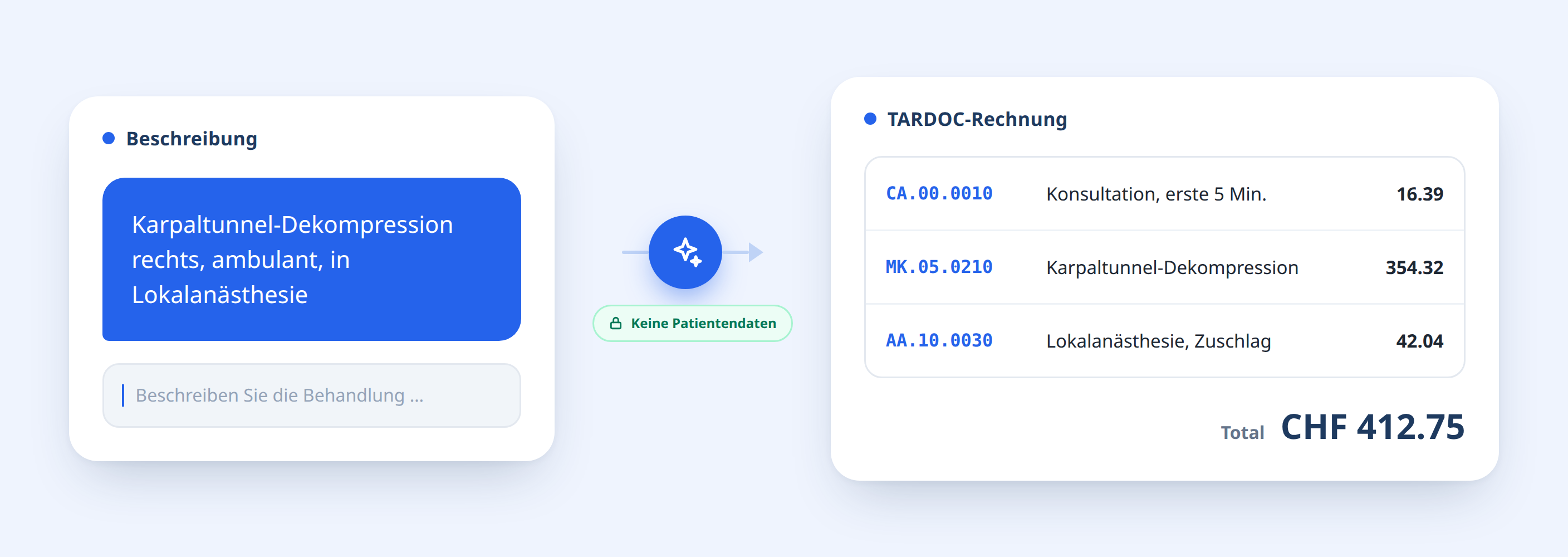
You type *"Karpaltunnel-Dekompression rechts, ambulant, in Lokalanästhesie."* The assistant searches the official catalogues — 1,388 TARDOC positions and 310 Ambulante Pauschalen — and answers with a proposal: the consultation, the procedure, the local-anaesthesia supplement. Each line carries its code, its tariff points and the amount your own tax-point value produces.
Then you read it. Accept it, change a line, or ask why it chose single positions over the flat rate — it explains the choice in words rather than showing you a rule number. Nothing touches the invoice until you press Übernehmen.
That is the whole idea. The tariff knowledge sits in the tool. The clinical judgement stays with you.
Nothing leaves the practice unchecked
An invoice that is merely plausible is still an invoice that comes back. Before a draft can become a real document, Viali checks the things a Swiss invoice cannot exist without.
Your GLN and ZSR, the insurer's GLN, the tax-point value behind the amounts — and, per position, who actually performed it. On a case where the surgeon operates and someone else anaesthetises, that distinction is the difference between a clean invoice and a returned one.
The invoice comes out ready to be paid
Tiers Garant or Tiers Payant, a Swiss QR-bill on the PDF, and an XML export for electronic submission to insurers via MediData. The payment slip is not a second piece of software you have to buy.
What it is not
Honesty is cheaper than a surprise later:
- It does not replace your judgement. Every proposal is a draft for a human to approve. It is an assistant, not an authority.
- It never sees your patients. Patient identity and insurance details are never sent to the AI. It works from the clinical description of the treatment — the procedure, the side, the anaesthesia — and nothing that identifies anybody.
- It is not a practice management system. No OR planning, no anaesthesia documentation, no rostering, no marketing. It bills. It sits next to whatever software you already run.
- It is one login. Team access starts at the next tier up.
Trying it
There is a 14-day free trial, no credit card, and then one flat price per practice per month. See Viali TARDOC for the current price and what is included, or the billing module inside the full platform if you also want the clinic side.
If you would rather fix your setup than change your software, the TARDOC checklist for practices is six steps and costs nothing.
Frequently asked questions
Do I need a billing specialist to invoice under TARDOC?
No, but you need something that knows the rules. The tariff is published in machine-readable form, so the position proposal and the rule validation can be automated — leaving the clinical judgement, which cannot.
Can a Belegarzt bill their own cases with it?
Yes. That is one of the two cases it was built for: a doctor who operates at a clinic they are not employed by and invoices independently, with no billing department behind them.
Does the AI see patient data?
No. Patient identity and insurance details are never transmitted to the AI. It receives only the clinical description needed to choose tariff positions.
What happens if the assistant proposes a wrong position?
You change or remove it before accepting. Proposals are never applied automatically, and the invoice is validated against the official rules before it can be exported or sent.
Do I have to replace my practice software?
No. Viali TARDOC is a standalone billing tool and runs alongside the software you already use.
Related articles
Billing
The TARDOC checklist for practices: six steps to clean billing
Sort the case mix, rebuild templates, validate before sending: the six steps separating smoothly billing practices from those fighting rejection piles.
Billing
Ambulante Pauschalen explained: when the flat rate applies — and when TARDOC does
Outpatient flat rates pay a treatment as one fixed amount and take precedence over TARDOC. When they apply — and which double-billing traps to avoid.
Billing
What is TARDOC? The new Swiss outpatient tariff explained
TARDOC replaced TARMED on 1 January 2026. What the new single-service tariff is, how positions and rules work — and what it means for your practice.
Billing
TARDOC vs. TARMED: what actually changes for your billing
Two systems instead of one, a rebuilt position catalogue and machine-checkable rules: the real differences between TARDOC and TARMED — and what they mean for billing teams.
Product · Anaesthesia
One anaesthesia team, many practices — a single plan
How an anaesthesia service runs every partner practice from one Viali tenant — the practice submits its operating day by link, staffing is ranked by commute time, and countersigned hours become the monthly statement.
Explore more
Viali TARDOC
The standalone Swiss billing assistant — TARDOC, Ambulante Pauschalen and QR-bill, from CHF 99 per month.
Invoice
TARDOC, Ambulante Pauschalen and QR-bill — Swiss outpatient invoicing.
Ready to experience this yourself?
Book a demo and see how Viali transforms your clinic operations.